CHRONIC STRESS AND THE NEED FOR RECOVERY
Everyday stress can impair healthy functioning and lead to a range of physiological and psychological symptoms, including sleep disturbances, loss of appetite, constipation, muscle tension and other stress-related conditions. When stress becomes prolonged, its effects can be far more serious, contributing to cardiovascular disease, hormonal imbalance, type 2 diabetes, increased susceptibility to infection and neurological disorders. Many psychiatric conditions—including schizophrenia, anxiety disorders, chronic fatigue syndrome and, in particular, depression—have also been strongly associated with prolonged stress responses.
Without adequate opportunities for recovery, chronic stress can have lasting consequences for both physical and mental health.
Adapted from Introduction to Biophilia, by Giuseppe Barbiero and Rita Berto.
STRESS RECOVERY THEORY
The Stress Recovery Theory (SRT) was developed by Roger Ulrich in 1983. In essence, it proposes that exposure to Nature promotes psychophysiological well-being by triggering emotional, cognitive and physiological responses that help the body recover from stress. These responses include reductions in heart rate, blood pressure, muscle tension and skin conductance, supporting recovery from psychophysiological stress.
According to the SRT, natural environments are restorative because they facilitate recovery from stress while rapidly evoking positive emotions and a state of relaxation. Viewing natural scenes has been associated with increased activity in brain regions linked to positive emotional states, emotional stability, empathy, altruism and compassion.

THE FIRST SCIENTIFIC EVIDENCE
Environmental psychologist Roger Ulrich, Professor of Architecture at Texas A&M University, is widely recognised as one of the pioneers in the study of the relationship between the built environment, health and well-being.
In 1984, Ulrich published a landmark study in Science demonstrating that hospital patients recovering from surgery whose rooms overlooked trees and natural vegetation experienced better outcomes than patients whose windows faced a brick wall. They had shorter hospital stays, required fewer analgesics and received more favourable evaluations from nursing staff.
This study provided one of the first scientific demonstrations that exposure to Nature can positively influence recovery. Together with Ulrich’s earlier theoretical work on Stress Recovery Theory, it laid the foundations for what later became known as Evidence-Based Design—the principle that the design of healthcare environments can have measurable effects on health and well-being.

BEYOND DIRECT EXPERIENCE OF NATURE: A NEW RESEARCH PERSPECTIVE
In the years that followed, Roger Ulrich expanded his research to investigate whether the restorative effects of Nature depended exclusively on direct physical exposure or could also be elicited through images and natural sounds.
In 1991, he published a study in which participants, after undergoing an experimentally induced stress condition, viewed video recordings of either natural or urban environments accompanied by their corresponding soundscapes. Those exposed to the natural scenes showed a faster emotional and physiological recovery than participants who viewed urban environments.
This study marked an important step in environmental psychology, providing evidence that audiovisual representations of Nature can also promote psychophysiological recovery. It opened new avenues of research into the use of Nature-based audiovisual experiences as a means of supporting well-being when direct contact with natural environments is not possible.

THE 2026 INTERNATIONAL MULTISITE REPLICATION
In 2026, the Journal of Environmental Psychologypublished the first large-scale international replication of Roger Ulrich’s landmark 1991 study. Ten research teams from universities across Europe and the United States collaborated to re-examine the original findings using contemporary research methods.
The study involved 959 participants, who were first exposed to an experimentally induced stress condition and then viewed videos with sound of either natural or urban environments. Both psychological responses and several physiological indicators of stress recovery were assessed.
The results confirmed Ulrich’s principal finding: participants who viewed natural environments experienced significantly greater psychological recovery than those who viewed urban scenes, showing improved mood and a faster reduction in negative emotions. Physiological responses were more nuanced, with some measures confirming the original findings while others revealed a more complex pattern of recovery.
This multisite replication is particularly significant because, using contemporary methods and a sample almost eight times larger than the original study, it confirms that simply viewing moving images of Nature can promote psychological recovery following a stressful experience.

Roger Ulrich’s research opened a new perspective: designing environments and experiences that promote psychophysiological recovery by drawing on the restorative qualities of Nature.
It is within this line of research that the Alamar Life Method® was developed.
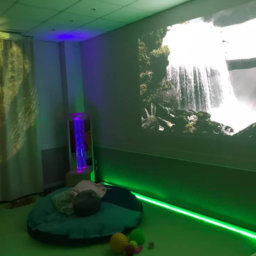
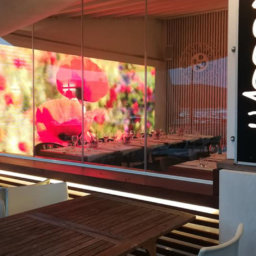
Its purpose is to bring the perceptual qualities of Nature into everyday environments through carefully designed audiovisual experiences that foster relaxation, balance and well-being.
NATURAL IMAGES AND SOUNDS CAN REDUCE THE PERCEPTION OF PAIN
Researchers at Johns Hopkins University in Baltimore found that exposure to natural imagery significantly reduced the perception of pain during medical procedures. The study involved patients undergoing bone marrow aspiration and biopsy.
Pain intensity was measured using a 0–10 numerical rating scale, where scores of 4 or higher indicate moderate to severe pain.
Participants were randomly assigned to one of three groups:
- Group 1: no visual images.
- Group 2: urban scenes displayed on large screens, accompanied by audio through headphones.
- Group 3: natural scenes displayed on large screens, accompanied by audio through headphones.
- No images: perceived pain 5.7
- Urban scenes: perceived pain 5.7
- Natural scenes: perceived pain 3.9
The researchers concluded: “The reduction in pain was not simply due to distraction, but to the calming effect that natural elements had on the patients.”


Building on Roger Ulrich’s pioneering research, numerous studies have further explored the role of Nature in stress recovery.
More recently, this line of research has also led to the investigation of Alamar Life audiovisual experiences, as demonstrated by the RestStress project.
More than forty years after the formulation of the Stress Recovery Theory, research continues to investigate the role of Nature in psychophysiological recovery from stress.
The national PRIN RestStress project, conducted by the APsyM Laboratory at the Department of Human Sciences, University of Verona, explored the mechanisms of stress recovery through two different forms of exposure to Nature.
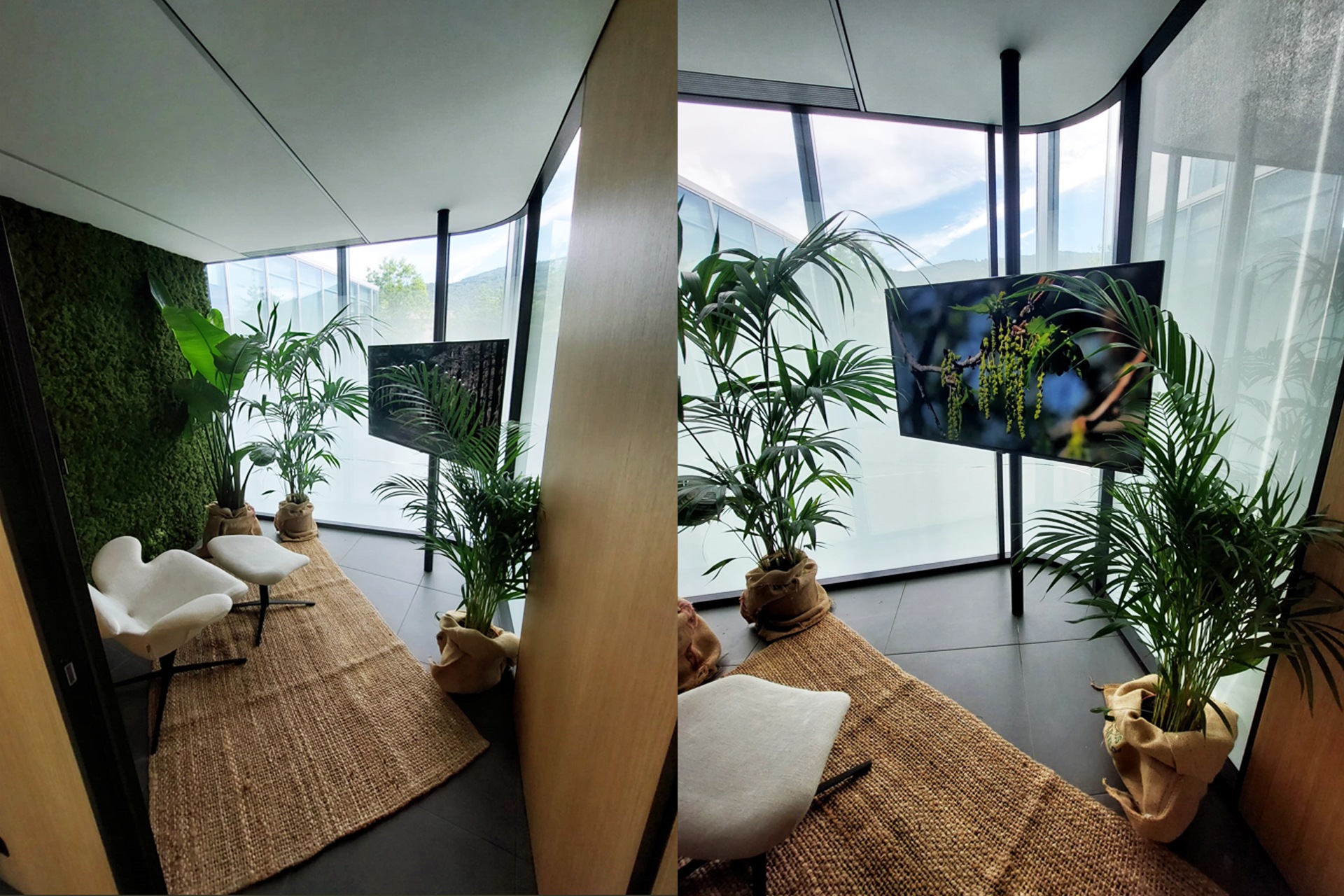
The University of Verona investigated the effects of immersive Nature experiences using Alamar Life audiovisual environments within a purpose-designed biophilic setting, while the “G. d’Annunzio” University of Chieti–Pescara examined the effects of direct contact with Nature through guided walks in natural environments.
The study involved 100 participants, who were exposed for 15 minutes a day over five consecutive days to five different natural environments: mountains, forests, the sea, flowers and streams. The results showed significant improvements in relaxation and calm, together with reductions in perceived stress, anxiety and heart rate.
+63% relaxation
+38% calm
−35% anxiety
−31% perceived stress
−7 bpm heart rate
These findings suggest that immersive audiovisual experiences designed to reproduce the perceptual qualities of Nature can support the psychophysiological recovery processes described by the Stress Recovery Theory.